AI Verify Testing Framework

Show Your AI Is Responsible, Safe, and Aligned with Global Standards

As organisations deploy systems with Artificial Intelligence (AI), 
it is important to be transparent about your AI systems to build trust with our stakeholders.

For business and compliance leaders, it means demonstrating that your AI systems are trustworthy and aligned with global standards. This is where the AI Verify Testing Framework comes in.

What is the AI Verify Testing Framework?

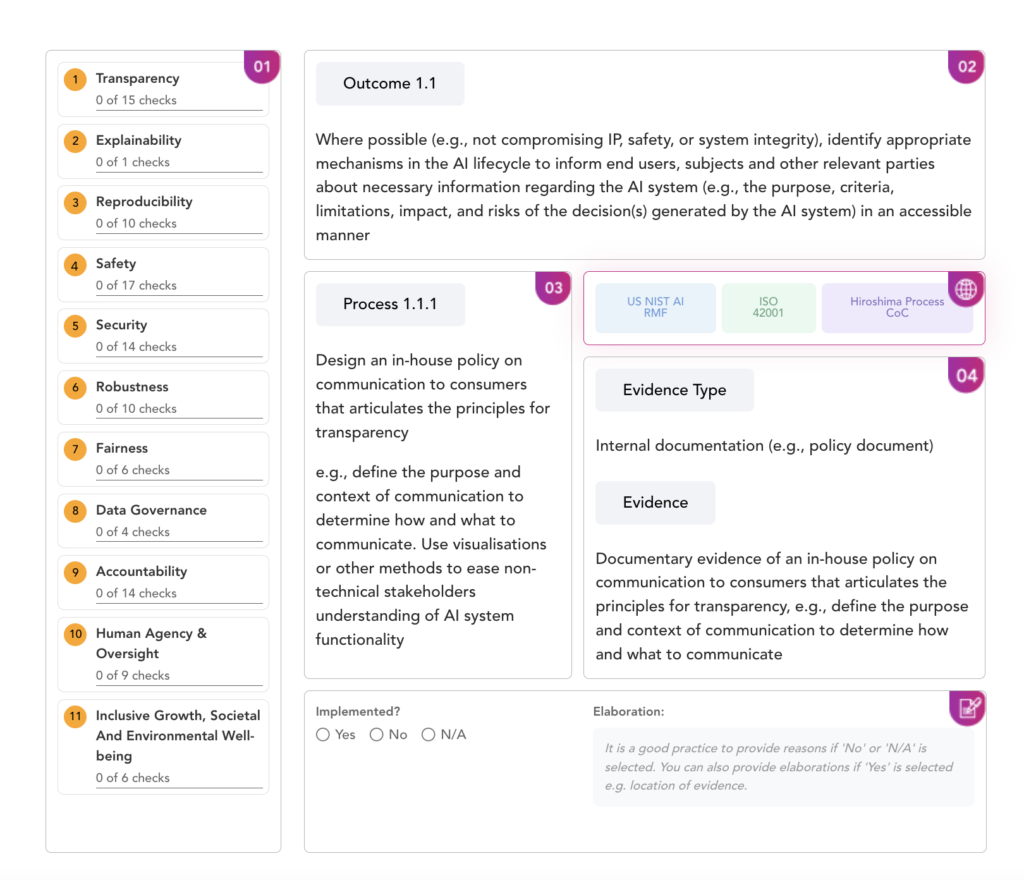
The Framework Is Mapped to Other Frameworks, Including:

ISO/IEC 42001:2023 is a first of its kind international standards designed to ensure broad responsible adoption of AI. The novel approach, in conjunction with the family of standards that ISO/IEC JTC 1/SC 42 is developing, provides a portfolio of international standards that countries and regions can rely on to enable trustworthy and transparent AI.

This mapping between AI Verify Framework and ISO/IEC 42001 demonstrates Singapore’s strong support in advancing global harmonisation in a practical way. It also shows the growing number of countries that are leveraging ISO/IEC 42001 to enable trustworthy AI adoption.

Wael William Diab
Chair, ISO/IEC JTC1 / SC42 on AI standards

How does the framework work?

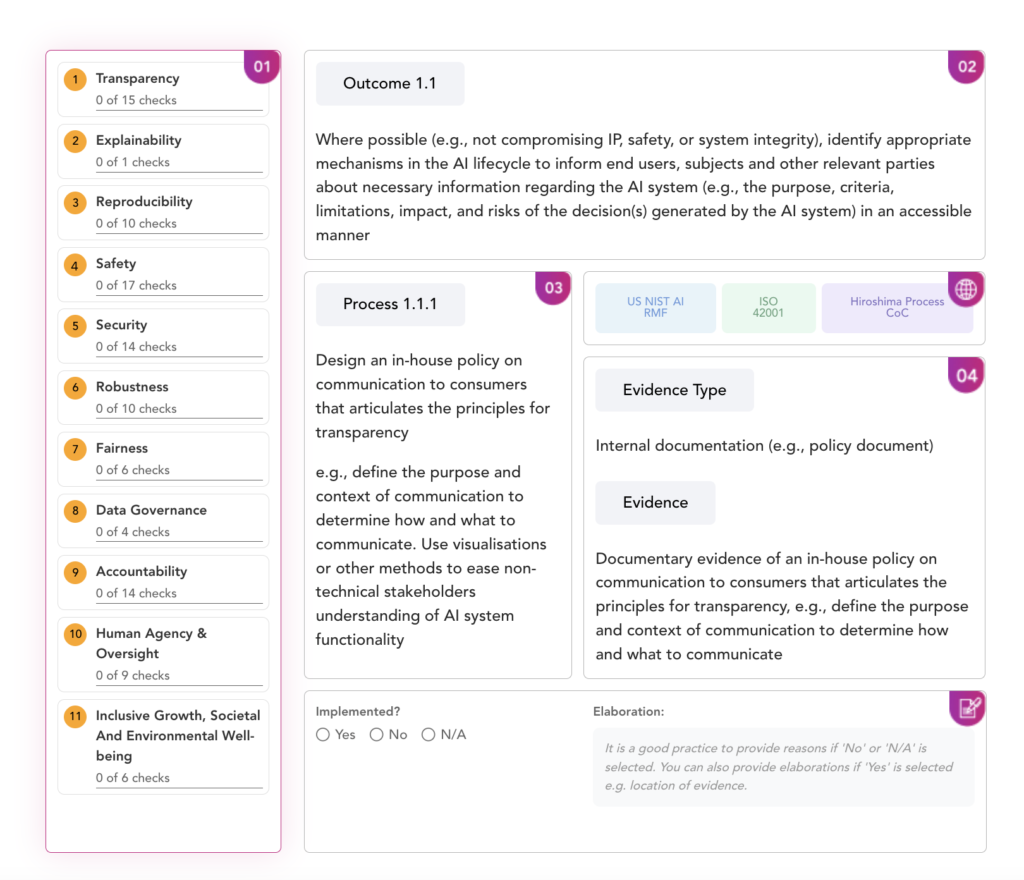
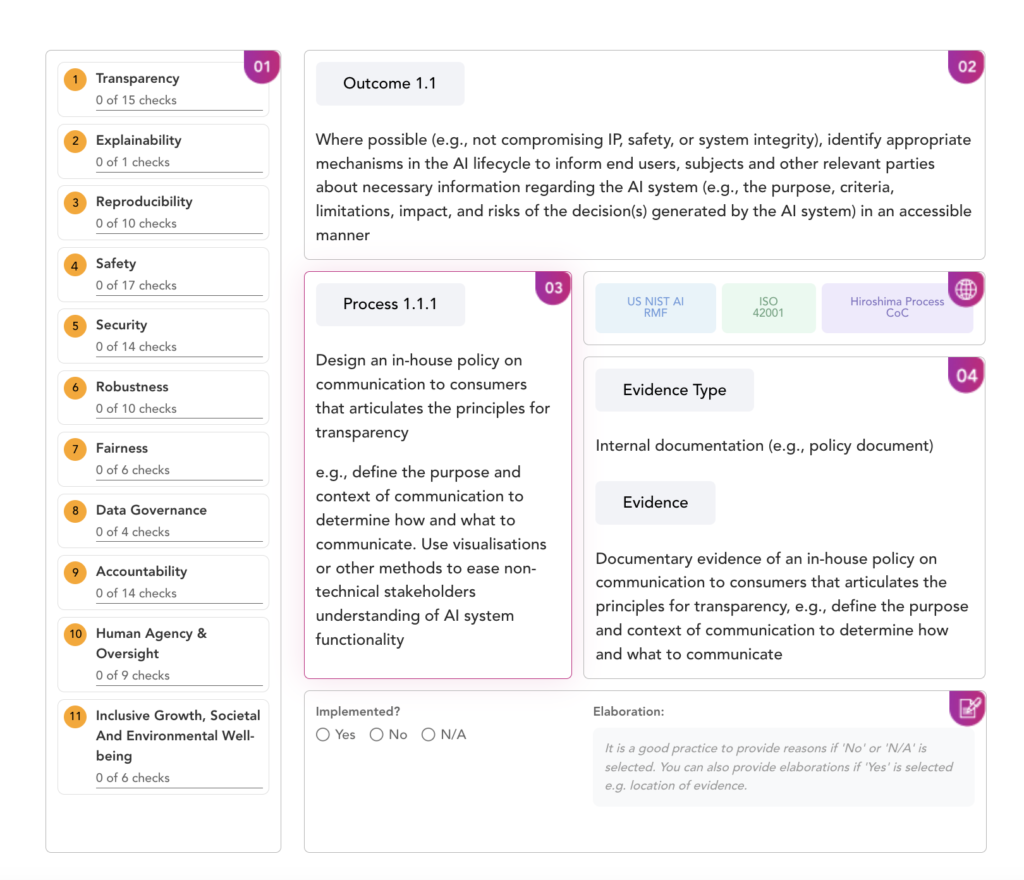
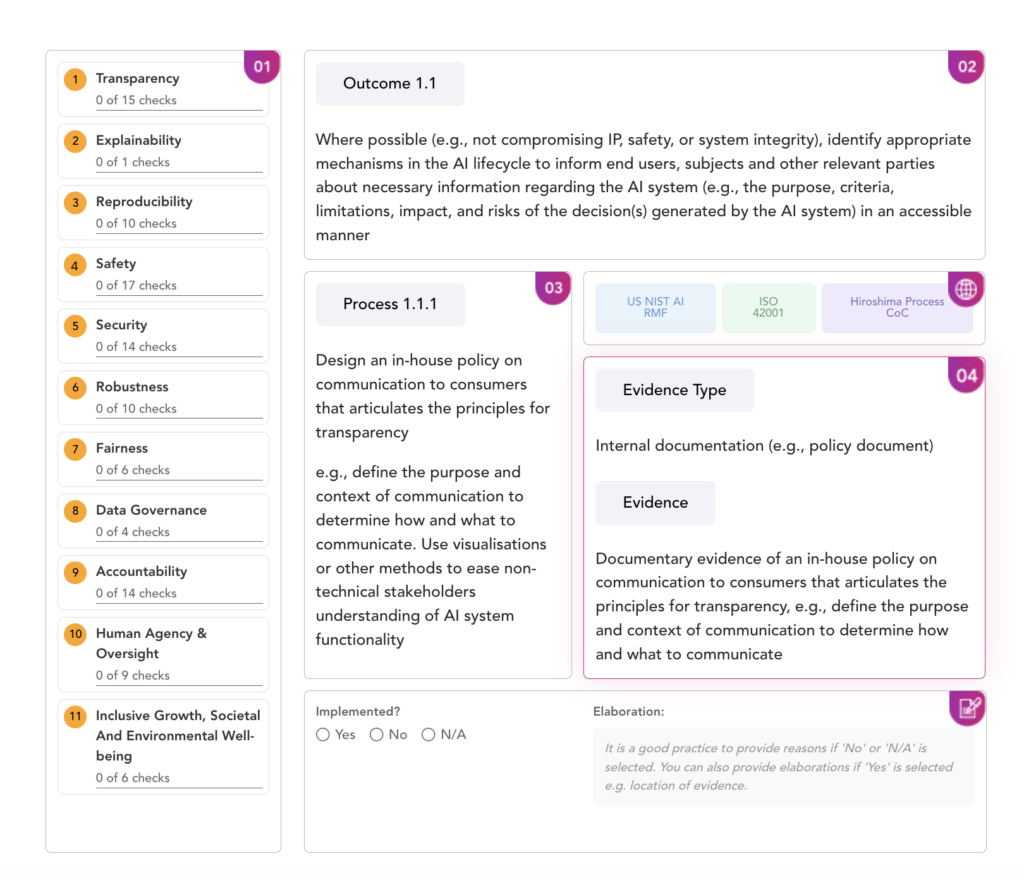
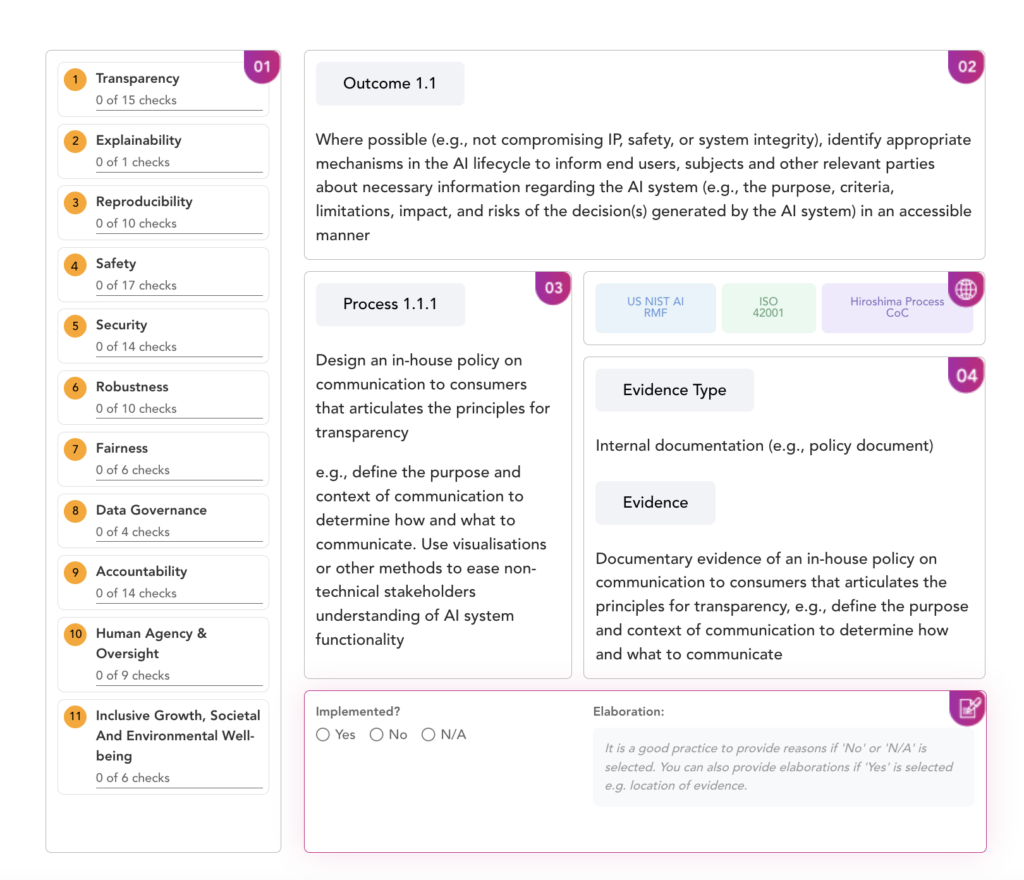
The framework has 4 key elements: Principles, Outcomes, Processes, Evidence

1
Transparency
0 of 15 checks
2
Explainability
0 of 1 checks
3
Reproducibility
0 of 10 checks
4️
Safety
0 of 17 checks
5
Security
0 of 14 checks
6
Robustness
0 of 10 checks
7
Fairness
0 of 6 checks
8
Data Governance
0 of 4 checks
9
Accountability
0 of 14 checks
10
Human Agency & Oversight
0 of 9 checks
11
Inclusive Growth, Societal And Environmental Well-being
0 of 6 checks

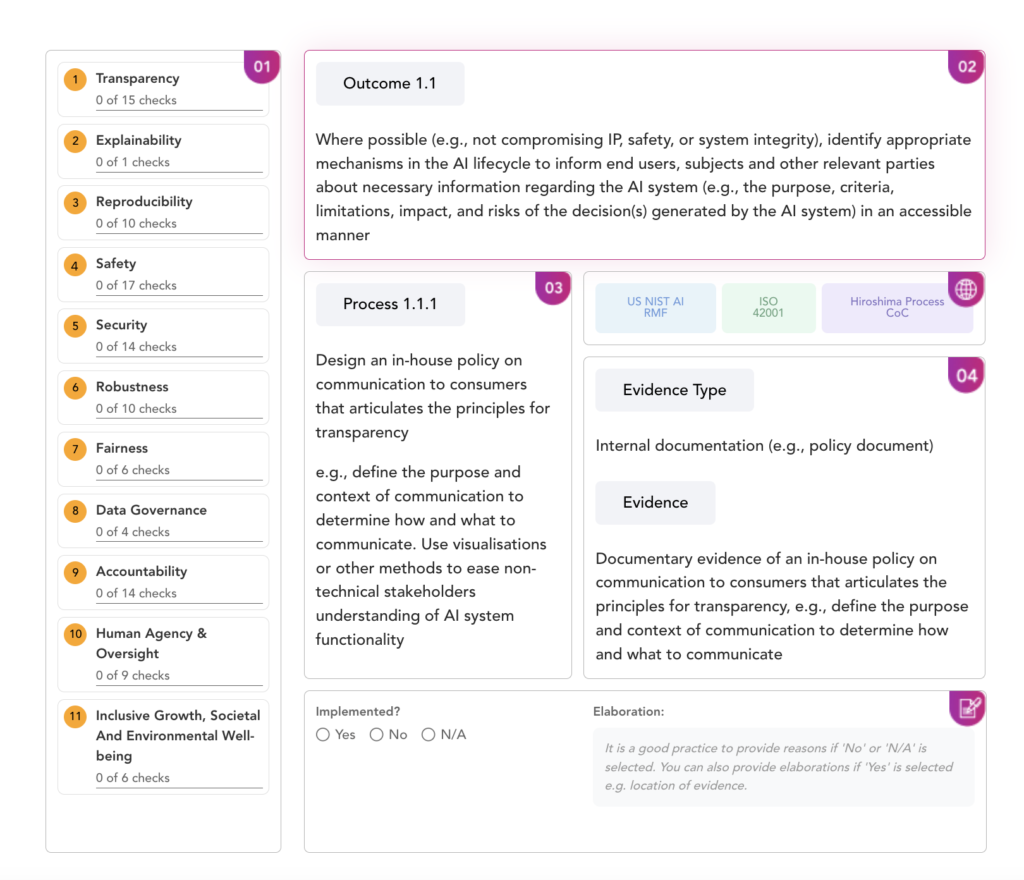
Where possible (e.g., not compromising IP, safety, or system integrity), identify appropriate mechanisms in the AI lifecycle to inform end users, subjects and other relevant parties about necessary information regarding the AI system (e.g., the purpose, criteria, limitations, impact, and risks of the decision(s) generated by the AI system) in an accessible manner


Design an in-house policy on communication to consumers that articulates the principles for transparency

e.g., define the purpose and context of communication to determine how and what to communicate. Use visualisations or other methods to ease non-technical stakeholders understanding of AI system functionality

Internal documentation (e.g., policy document)

Documentary evidence of an in-house policy on communication to consumers that articulates the principles for transparency, e.g., define the purpose and context of communication to determine how and what to communicate

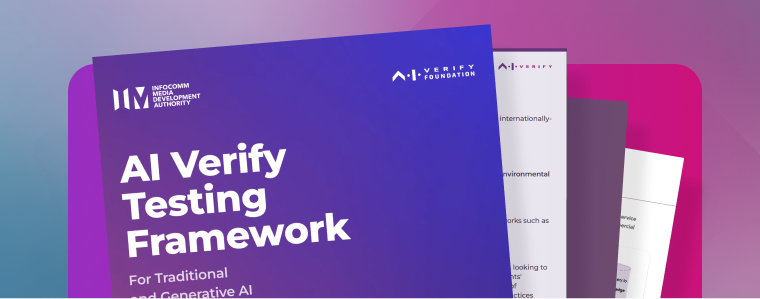
PDF Version

Use this version if you want to get an overview of the framework

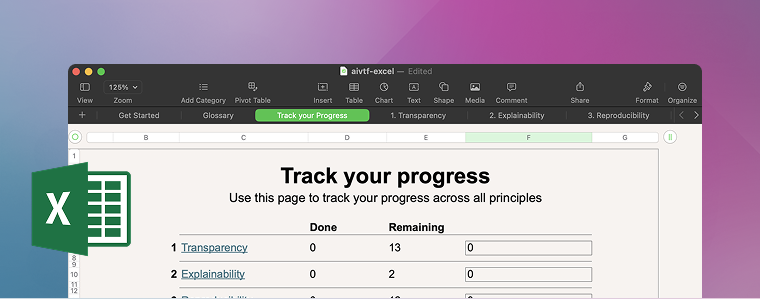
Excel Version

Use this version if you want to track 
your progress in completing the 
process checklist

Software Tool (GenAI only)

Use this version if you want to 
document your practices and generate 
a summary report

How Does the Framework Work?

The framework has 4 key elements: Principles, Outcomes, Processes, Evidence

1
Transparency
0 of 15 checks
2
Explainability
0 of 1 checks
3
Reproducibility
0 of 10 checks
4️
Safety
0 of 17 checks
5
Security
0 of 14 checks
6
Robustness
0 of 10 checks
7
Fairness
0 of 6 checks
8
Data Governance
0 of 4 checks
9
Accountability
0 of 14 checks
10
Human Agency & Oversight
0 of 9 checks
11
Inclusive Growth, Societal And Environmental Well-being
0 of 6 checks

Where possible (e.g., not compromising IP, safety, or system integrity), identify appropriate mechanisms in the AI lifecycle to inform end users, subjects and other relevant parties about necessary information regarding the AI system (e.g., the purpose, criteria, limitations, impact, and risks of the decision(s) generated by the AI system) in an accessible manner

Design an in-house policy on communication to consumers that articulates the principles for transparency

e.g., define the purpose and context of communication to determine how and what to communicate. Use visualisations or other methods to ease non-technical stakeholders understanding of AI system functionality

Internal documentation (e.g., policy document)

Documentary evidence of an in-house policy on communication to consumers that articulates the principles for transparency, e.g., define the purpose and context of communication to determine how and what to communicate

PDF Version

Tip: Use this version if you want to get an overview of the framework

Excel Version

Tip: Use this version if you want to track your progress in completing the process checklist

Software Tool (GenAI only)

Tip: Use this version if you want to document your practices and generate a summary report

How Does the Framework Work?

The framework has 4 key elements: Principles, Outcomes, Processes, Evidence

PDF Version

Tip: Use this version if you want to get an overview of the framework

Excel Version

Tip: Use this version if you want to track your progress in completing the process checklist

Software Tool (GenAI only)

Tip: Use this version if you want to document your practices and generate a summary report

Use the Process Checks Tool to Document Your Framework Implementation and Generate a Summary Report

The testing framework (Generative AI) is available in a software tool. It can help you:

The AI Verify Testing Framework is also complemented by technical testing tools for Traditional AI and Generative AI.

Who Is This For?

01
AI Application Owners/ Developers

Demonstrate and document responsible AI practices

02
Internal Compliance
Teams

Ensure responsible AI practices are in place

03
External
Auditors

Independently validate your client’s responsible AI implementations

04
Policymakers/ Standards Organisations

Reference to inform best practices and standards development in AI testing

How Was the Testing Framework Developed?

AI Verify was developed in consultation with companies from different sectors and of different scale. These companies include – AWS, Basis.AI, DBS Bank, Google, Meta, Microsoft, Singapore Airlines, NCS (part of Singtel Group), Land Transport Authority, Standard Chartered Bank, UCARE.AI, and X0PA.AI.

25 May 2022

AI Verify Testing Framework for traditional AI and software Toolkit was launched as a Minimum Viable Product (MVP) for international pilot and feedback by IMDA and PDPC.

7 June 2023

AI Verify Testing Framework and Toolkit was open-sourced in GitHub.

29 May 2025

The updated AI Verify Testing Framework was released. The testing framework has been enhanced to address risks posed by Generative AI. With this update, companies can now apply AI Verify Testing Framework for both traditional and Gen AI use cases.